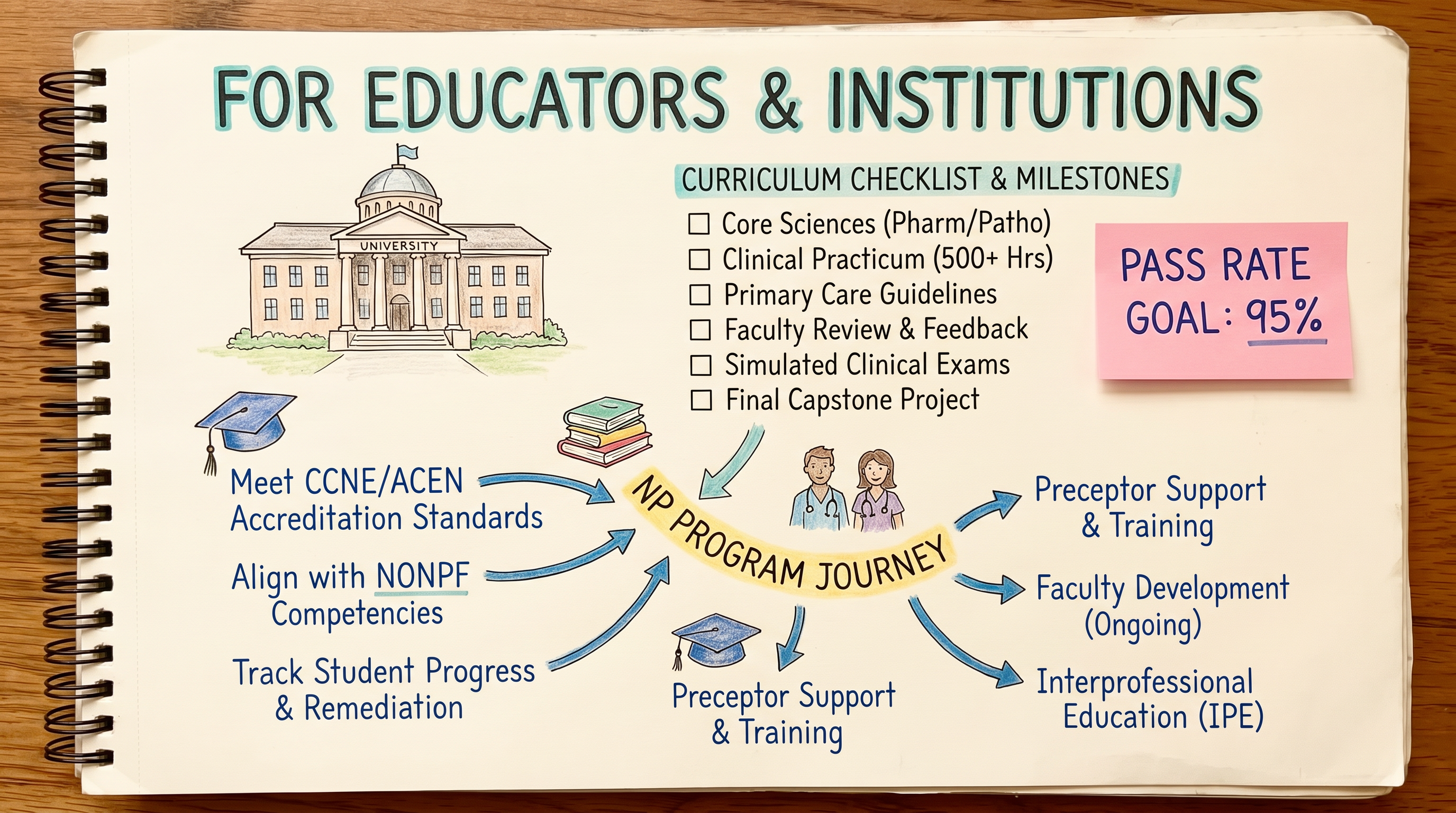
Online NP programs face unique quality challenges. Here is what the evidence says about maintaining rigorous clinical education standards in a distributed learning environment.
Online NP programs have grown dramatically over the past decade — driven by student demand for flexible, accessible education and by the technology infrastructure that makes high-quality online learning possible. Today, the majority of NP students are enrolled in programs with significant online components, and fully online programs are among the fastest-growing segments of NP education.
This growth has been accompanied by concerns about quality — concerns that are not unfounded. Online education presents genuine challenges for clinical education: ensuring the quality of clinical placements, maintaining academic integrity, building community and professional identity, and providing the kind of individualized feedback that clinical education requires.
This article examines the evidence on quality in online NP programs and offers practical strategies for maintaining rigorous clinical education standards in a distributed learning environment.
The Quality Challenges of Online NP Education
The quality challenges of online NP education are real and well-documented:
Clinical placement quality. Online programs that enroll students from across the country face significant challenges in ensuring the quality of clinical placements. When students arrange their own placements — as many online programs require — the quality of those placements varies enormously.
Academic integrity. Online assessments are more vulnerable to academic dishonesty than in-person assessments. This is a particular concern for programs that use online examinations as a primary assessment method.
Community and professional identity. The development of professional identity is partly a social process that occurs through interaction with peers, faculty, and clinical mentors. Online programs that do not invest in community-building may produce graduates who lack the professional identity and collegial networks that support long-term career success.
Faculty-student interaction. Clinical education requires individualized feedback and mentoring — a time-intensive process that is more difficult to deliver effectively in an online environment.
Clinical Placement Quality Assurance
The most important quality challenge for online NP programs is ensuring the quality of clinical placements. Effective clinical placement quality assurance strategies:
Preceptor vetting. All preceptors should be vetted before students begin clinical rotations — verifying their credentials, clinical experience, and willingness to provide high-quality supervision.
Site visits and audits. Programs should conduct regular site visits or audits of clinical placement sites — either in person or virtually — to assess the quality of the clinical environment and the preceptor-student relationship.
Student feedback mechanisms. Students should have a mechanism for providing feedback on their clinical placements — including concerns about preceptor quality, clinical environment, and learning opportunities.
Placement databases. Programs that maintain databases of vetted, high-quality clinical placements — and that actively manage relationships with those sites — consistently produce better clinical outcomes than those that rely on students to find their own placements.
Technology for Clinical Education
Technology can play an important role in maintaining clinical education quality in online programs — not by replacing clinical experiences, but by enhancing them.
Virtual simulation. High-quality virtual simulation platforms provide students with opportunities to practice clinical reasoning and decision-making in realistic clinical scenarios — supplementing their in-person clinical experiences.
Telehealth-based supervision. Faculty can observe and supervise student clinical encounters via telehealth — providing real-time feedback and assessment without being physically present at the clinical site.
Video-based reflection. Students who record and review their clinical encounters — with faculty feedback — develop clinical skills more rapidly than those who rely solely on preceptor feedback.
Online case-based learning. Asynchronous case-based learning platforms allow students to work through complex clinical cases collaboratively — building clinical reasoning skills in a distributed learning environment.
Building Community in Online Programs
Building a sense of community and professional identity in online programs requires intentional investment. Strategies that work:
Synchronous learning experiences. Regular synchronous sessions — video conferences, case conferences, and skills workshops — build community and provide the face-to-face interaction that is essential for professional identity development.
Cohort-based learning. Programs that enroll students in cohorts — groups of students who move through the program together — build stronger communities than those that allow students to progress at their own pace.
Mentorship programs. Formal mentorship programs that connect students with faculty mentors and alumni provide the individualized support and professional connection that online students often lack.
In-person intensives. Many online programs include periodic in-person intensives — multi-day on-campus experiences that provide simulation training, skills workshops, and community-building opportunities. These intensives are among the most valued components of online NP programs.
The Accreditation Perspective
Accreditation bodies have developed specific standards for online NP programs that address the quality challenges described above. CCNE and ACEN both require online programs to demonstrate that they maintain the same quality standards as in-person programs — including clinical placement quality, faculty-student interaction, and student learning outcomes.
Programs that are considering transitioning to online delivery — or that are expanding their online offerings — should carefully review the accreditation standards for online programs and ensure that their quality assurance processes are sufficient to meet those standards.
Free Resource
Get the Free FNP Board Study Guide
A comprehensive, no-fluff guide covering the highest-yield topics, pharmacology frameworks, and a week-by-week study plan. Free, instantly.
No spam, ever. Unsubscribe anytime.